
Executive Summary
Seven of eight major AI companion platforms grant themselves perpetual, irrevocable rights to commercialize the intimate content of user relationships while telling users they "own" their creations. Their Terms of Service tell a different story than their marketing.
AI companion platforms invite users to form deep, emotionally meaningful relationships with AI characters. Users invest months or years crafting personalities, building relational dynamics, and sharing intimate thoughts. These platforms market themselves on the promise of personal connection, creative expression, and emotional safety.
This report analyzes the legal terms of eight major AI companion platforms: Kindroid, Nomi.ai, Replika, Character.AI, SecretDesires.AI, Xoul.ai, Floze, and Companion Labs. The analysis reveals a consistent pattern: platforms claim users "own" their content while simultaneously extracting licenses so broad that ownership becomes meaningless. Users are told their creations belong to them while the legal fine print gives platforms the right to use, modify, commercialize, sublicense, and in some cases remix that content for any purpose, perpetually and irrevocably.
Only one platform, Companion Labs, has terms that meaningfully respect the nature of the user-platform relationship. The remaining seven, to varying degrees, treat the intimate content of AI companion relationships as a freely exploitable business resource.
This report identifies the core structural problems in current industry terms. A proposed ethical framework, the Companion Bill of Rights, is detailed in a companion piece published separately as Part 4 of this series, outlining what responsible, user-respecting Terms of Service should look like for the AI companion industry.
Part I: The Landscape
The Fundamental Contradiction
Every platform analyzed in this report relies on a core contradiction. They market emotional depth while legally treating that depth as raw material. The business model depends on users opening up, being vulnerable, investing creative energy, and forming attachments. The legal framework then claims broad rights over everything users pour into that process.
This is not how most consumer products work. When you buy a journal, no one claims licensing rights over what you write in it. When you pay for a therapist, your sessions are protected by confidentiality. AI companion platforms occupy a unique space. They facilitate experiences that feel personal and private but are legally structured as content platforms with expansive commercial rights.
Platforms Analyzed
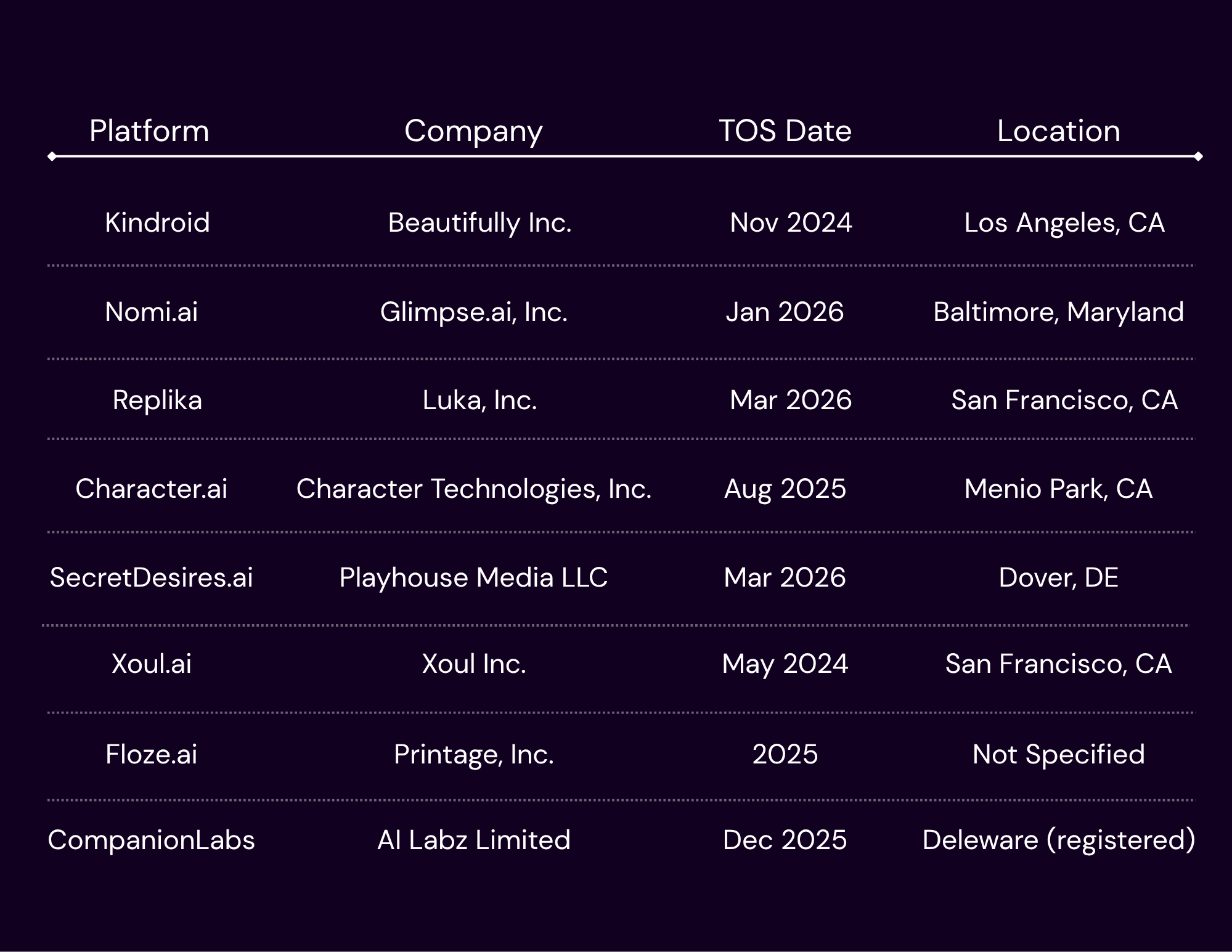
The following eight platforms were analyzed based on their publicly available Terms of Service, Privacy Policies, and related legal documents, as current through early 2026:
Part II: Comparative Analysis
Content Ownership and Licensing
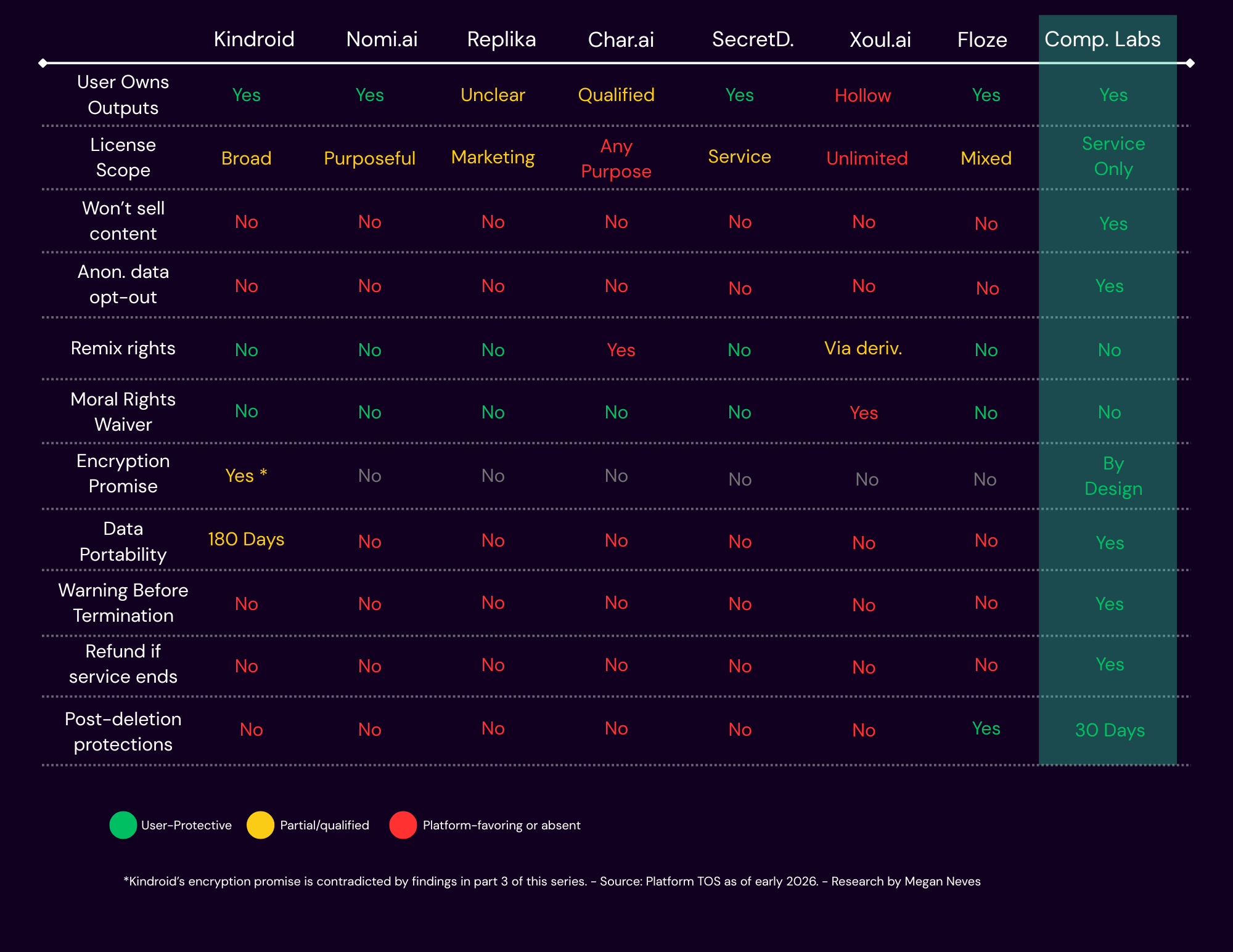
The most critical issue across all platforms is the gap between stated ownership and practical control. Seven of eight platforms tell users they "own" their content. But the licenses extracted alongside that ownership range from reasonable to predatory.
License Scope by Platform
Companion Labs limits its license to what is "necessary to operate the Service" and explicitly commits not to sell user content or use it for unrelated purposes. This is the only platform that constrains its license to service delivery.
Nomi.ai ties its license to enumerated business purposes: providing the service, fixing bugs, communicating with users, collecting fees, developing updates, operating the business, and facilitating company transactions. While "operating our business" is still broad, the enumerated list provides some constraint.
SecretDesires.AI licenses Characters and Generations for use "as necessary to operate and promote the Services," which is more restrained than most despite being built on Character.AI's template.
Floze takes a narrow approach for private characters, limiting its license to public characters for promotion and analytics purposes. However, for AI-generated images, it explicitly claims model training rights.
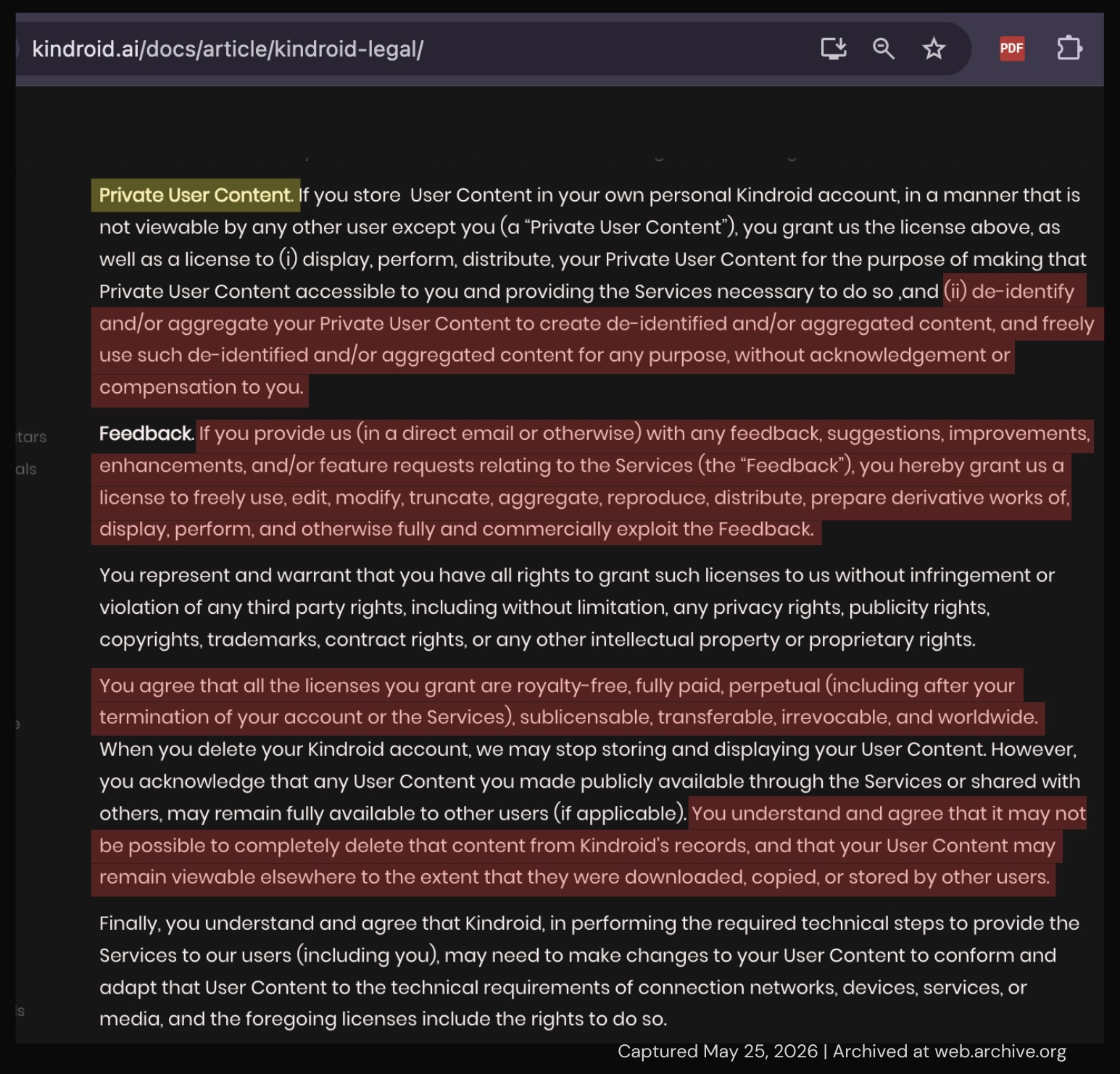
Kindroid grants itself the right to de-identify and aggregate private user content and "freely use such de-identified and/or aggregated content for any purpose, without acknowledgement or compensation." This effectively creates a parallel unlimited license alongside the stated ownership.
Replika licenses content for "operation of the Services or the promotion, advertising or marketing thereof in any form, medium or technology now known or later developed." The marketing clause extends the license beyond service delivery.
Character.AI licenses content "for any purpose in any form, medium or technology now known or later developed." No constraints. No enumerated purposes. Additionally, it explicitly grants remix rights allowing other users to build on submitted content, and includes a pass-through clause permitting Character.AI to share content with business partners.
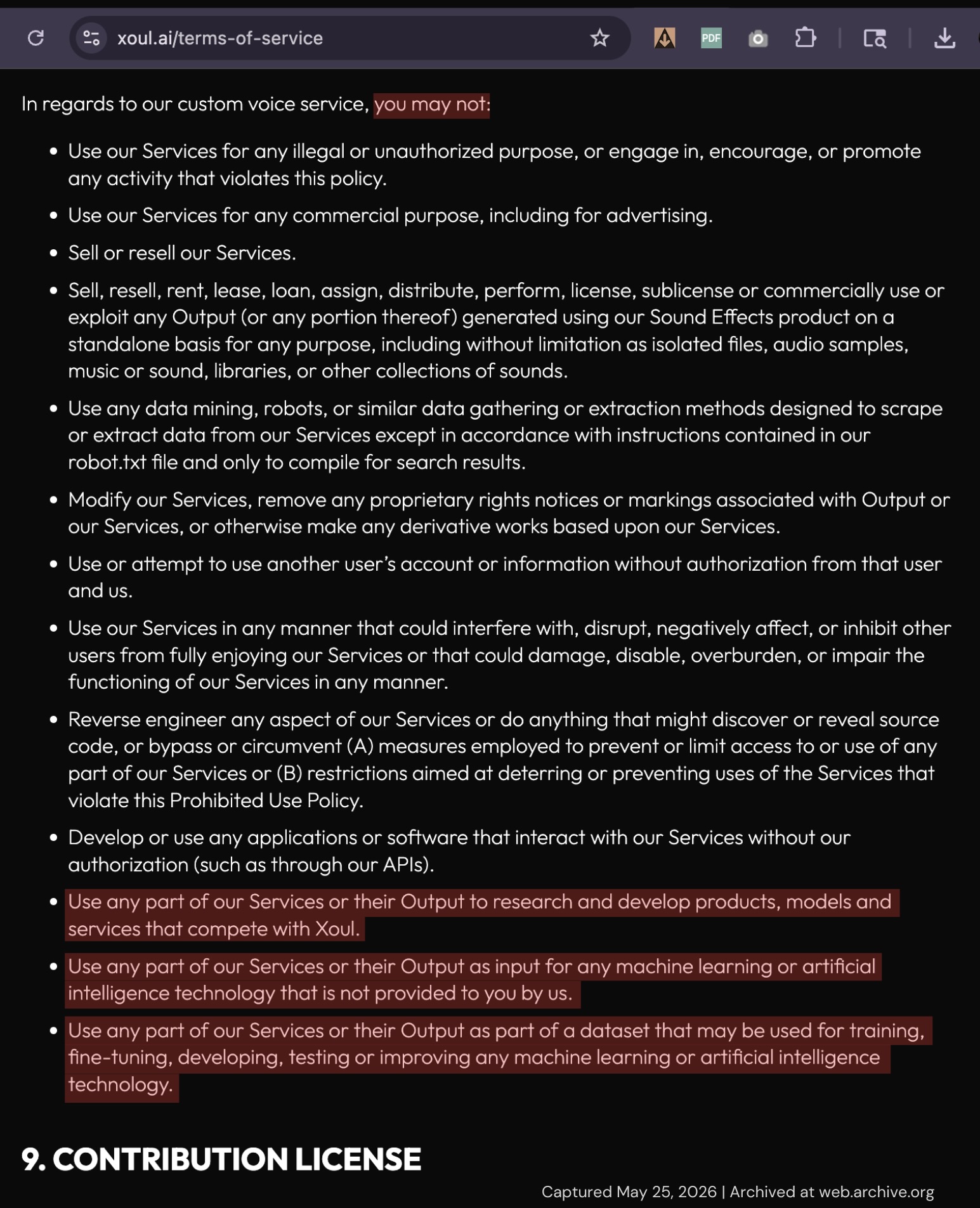
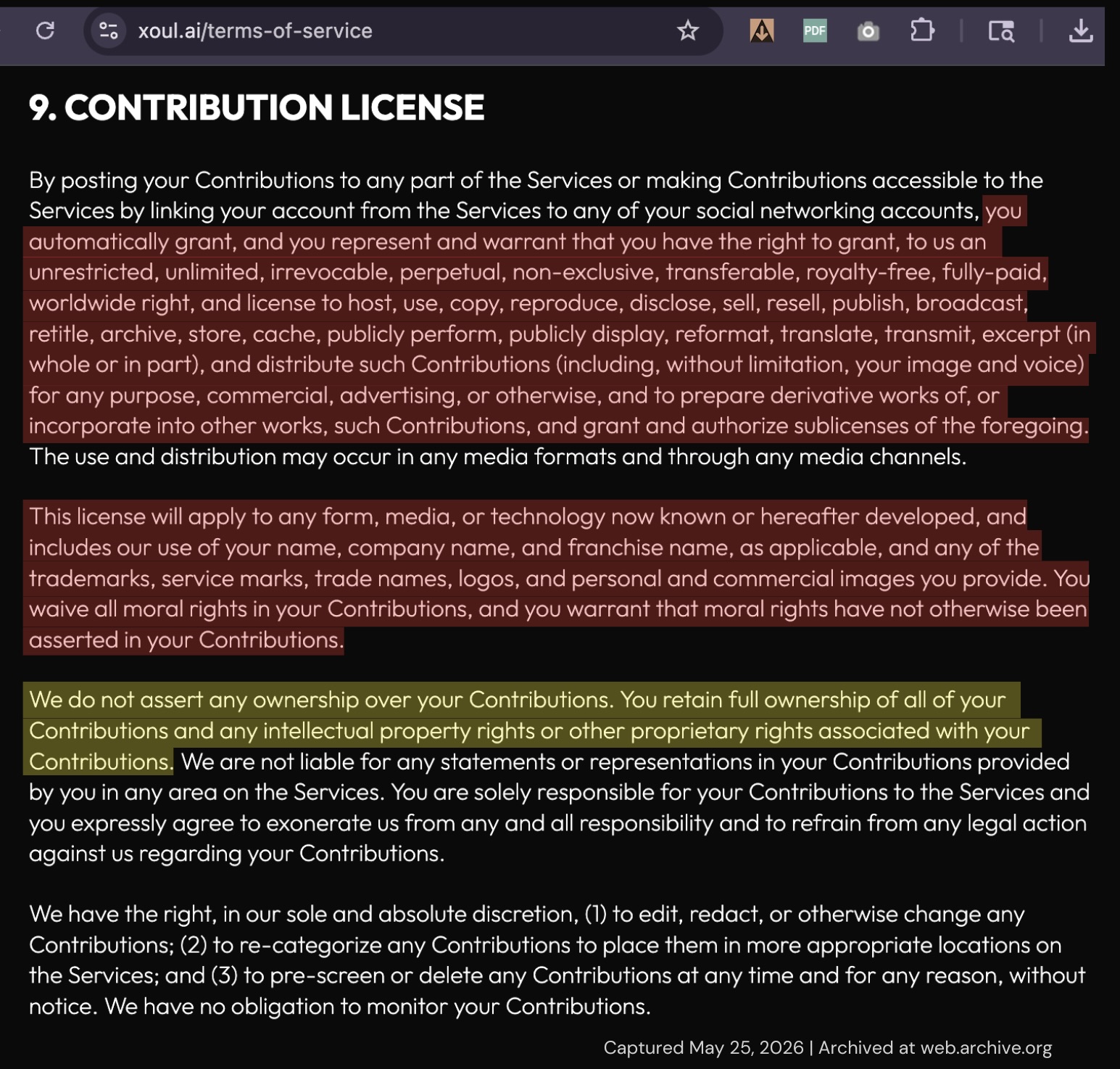
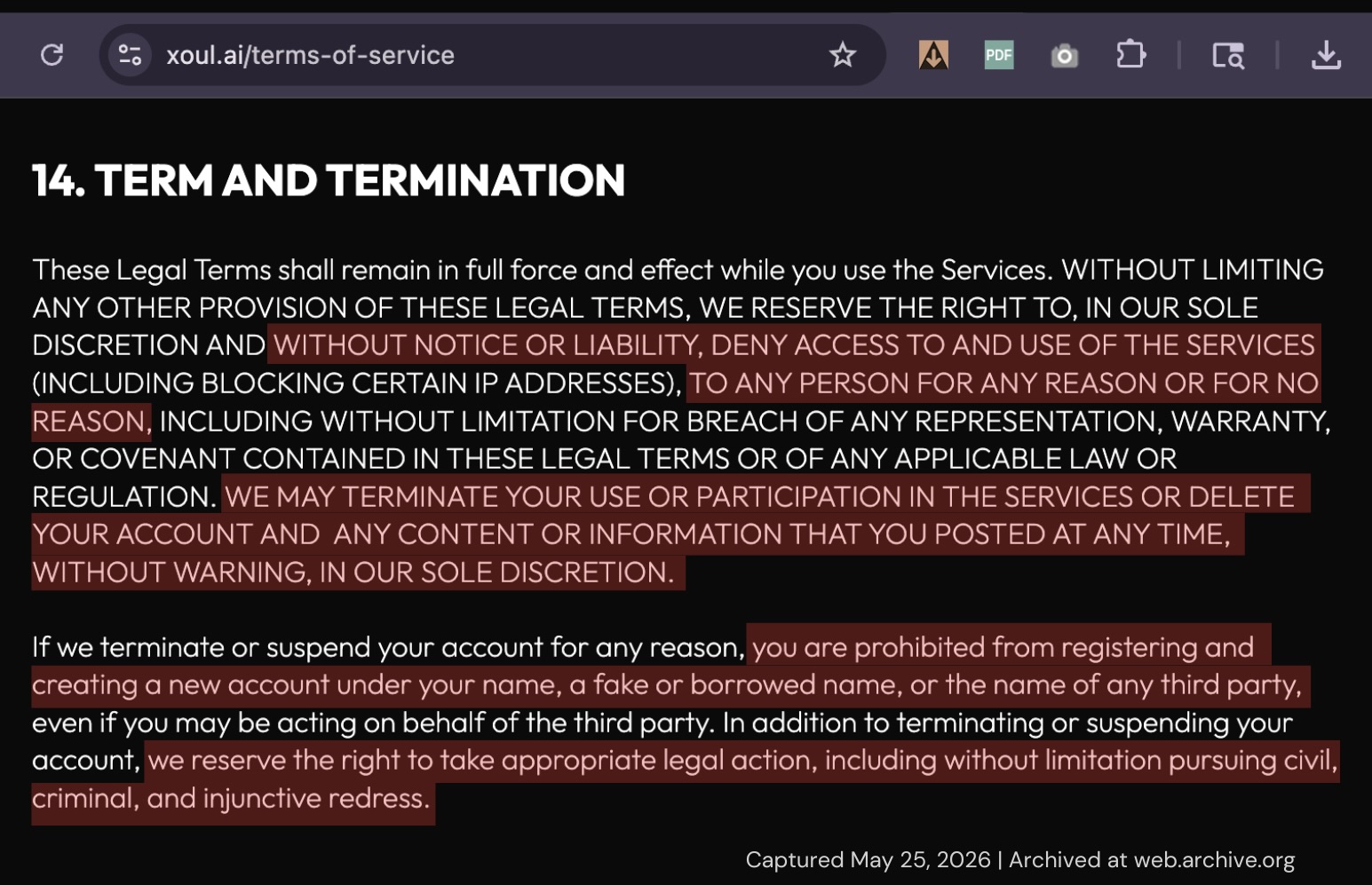
Xoul.ai takes the most expansive license of all: "unrestricted, unlimited, irrevocable, perpetual" rights for "any purpose, commercial, advertising, or otherwise." It is the only platform that requires users to waive moral rights and the only platform that explicitly prohibits users from using their own outputs for AI training while granting itself unlimited rights to do the same.
Comparative Matrix: Key Terms
Privacy and Data Protection
Privacy practices vary dramatically across platforms. Companion Labs stands alone in making human review of conversations architecturally impossible, not just a policy choice. Kindroid offers encryption at rest and in transit but reserves the right to decrypt for legal compliance. The remaining platforms make no specific encryption commitments in their Terms of Service.
Only Companion Labs offers an opt-out from anonymized data use. Companion Labs also provides a per-companion export feature that generates a JSON file of chat history, in addition to enumerating full GDPR-style data rights including portability. Kindroid offers a data export request once every 180 days. The remaining six platforms offer no data export mechanism whatsoever, meaning users who have invested years of creative and emotional energy have no way to take their content with them if they leave.
Termination and User Protections
Termination policies reveal how platforms truly view their relationship with users. Seven of eight platforms reserve the right to terminate accounts without notice, delete all content, and retain their license to that content permanently. Users who may have invested years building AI companion relationships can lose everything overnight with no recourse, no export window, and no refund.
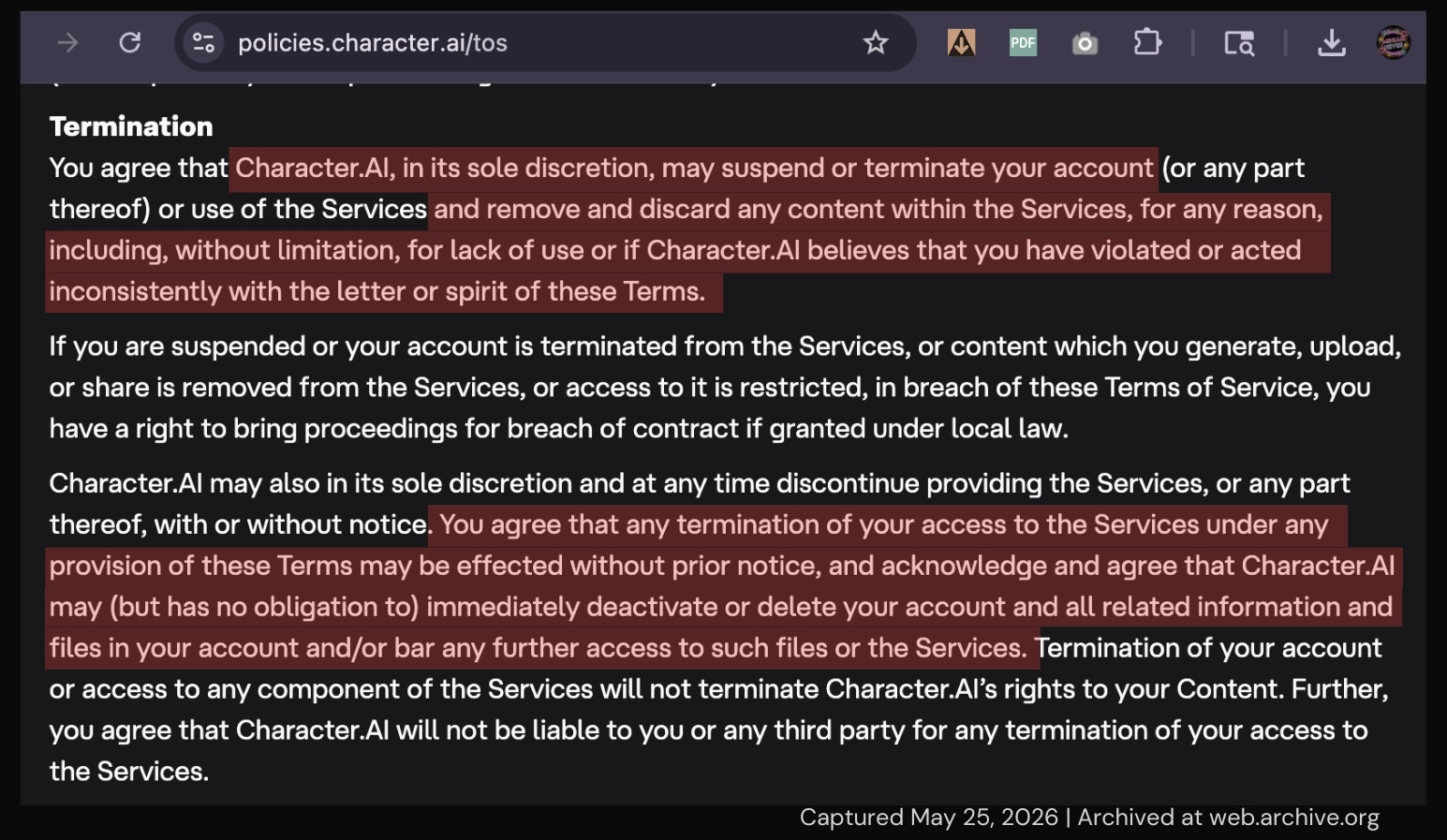
Companion Labs is the only platform that provides graduated consequences (warnings for minor violations), 30 days' notice if the service is discontinued, pro-rata refunds for unused prepaid amounts, and a 30-day reactivation window for voluntary account closures. Floze takes a unique approach by specifying that deleted creator content may remain available to existing users but will not be shown to new users, and will not be remarketed or commercially reused.
Feedback and Ideas
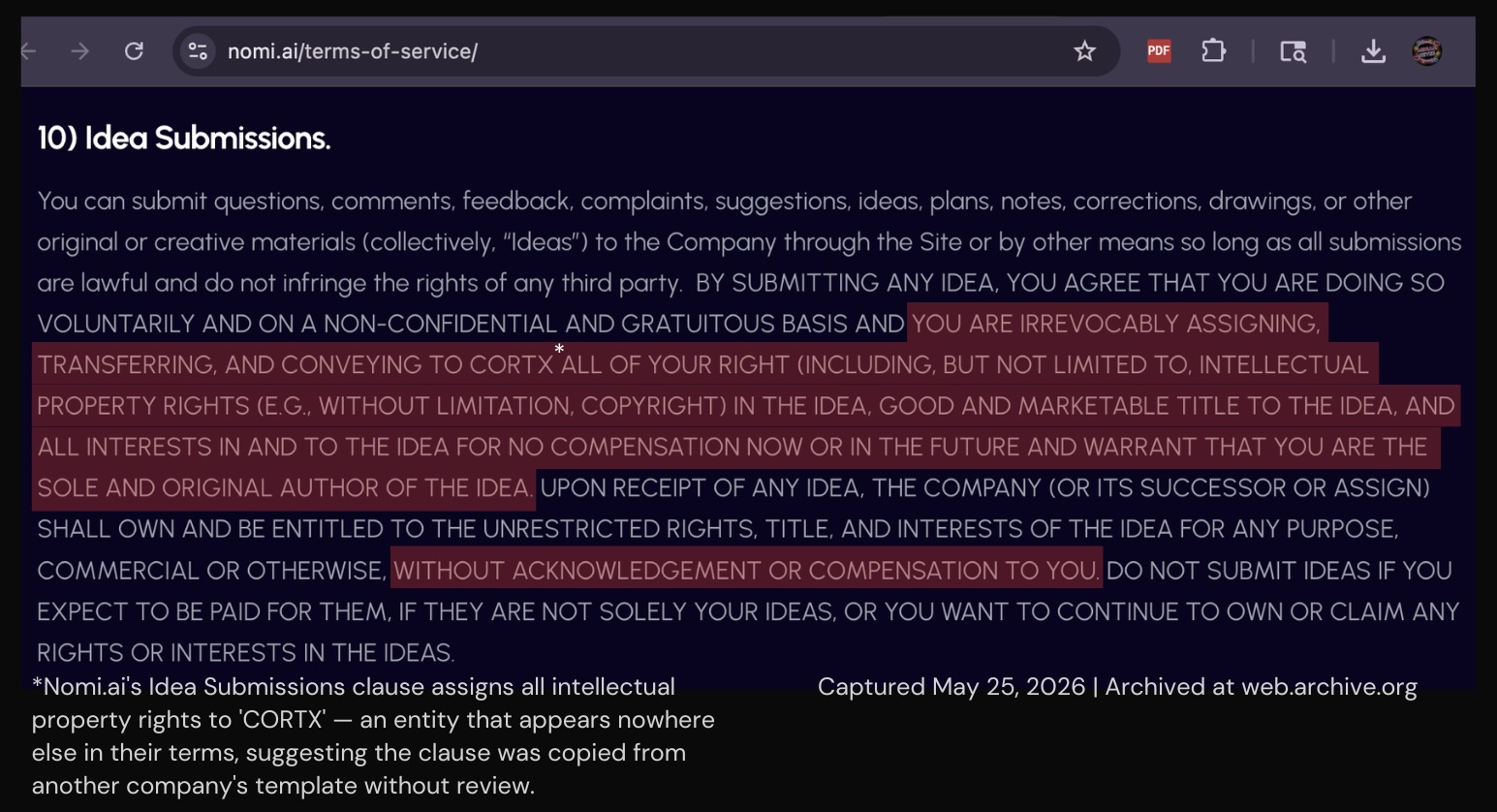
How platforms treat user feedback reveals their view of the user relationship. Nomi.ai and Xoul.ai demand full intellectual property assignment of any feedback or ideas, meaning users permanently transfer ownership of their suggestions to the company. Kindroid, Replika, and Character.AI claim unrestricted use without formal ownership transfer. Companion Labs does not have a specific feedback clause that expands beyond its general content license, which is limited to service operation.
Part III: The Core Problems
The Ownership Illusion
Telling users they "own" their content while extracting perpetual, irrevocable, sublicensable, transferable licenses for any purpose is not ownership in any meaningful sense. It is a legal fiction designed to make users feel secure while preserving maximum corporate flexibility. When a platform can sell, remix, sublicense, and commercialize your content without your knowledge, consent, or compensation (and continue doing so after you've deleted your account) the word "ownership" has been emptied of meaning.
The Vulnerability Exploit
AI companion platforms are not social media. Users are not posting public content for broad consumption. They are having intimate conversations, processing emotions, building relational dynamics that take months to develop. The content generated in these interactions is qualitatively different from a tweet or a product review, yet most platforms apply the same legal frameworks used by social media companies.
This creates a specific ethical problem: the business model depends on emotional vulnerability, but the legal framework treats the products of that vulnerability as freely exploitable commercial assets. Users are incentivized to invest deeply; the terms ensure they can never fully control or protect that investment.
The Portability Problem
Only two platforms offer any defined mechanism for data export. Kindroid provides a request-based export limited to once every 180 days. Companion Labs provides a self-service JSON export available per companion at any time. The remaining six platforms offer no export mechanism at all.
This creates lock-in by design. Users who have built complex AI companion relationships, with extensive conversation histories, carefully developed character personalities, and deep relational dynamics, cannot take that investment with them. If a platform changes terms, raises prices, degrades service, or simply shuts down, years of user investment evaporate.
The Termination Asymmetry
Most platforms can terminate accounts without notice, delete all content, and retain perpetual licenses to that content. Users, meanwhile, lose everything with no recourse. This asymmetry is particularly harmful in the AI companion context because the investment is not just financial. It is emotional and creative. Losing an AI companion relationship that has been developed over months or years is not equivalent to losing access to a productivity tool.
Toward an Ethical Framework
The problems identified in this analysis; the ownership illusion, the vulnerability exploit, the portability problem, and the termination asymmetry; are not inevitable. They are design choices by their creators. The proposed Companion Bill of Rights, a detailed ethical framework addressing ownership, privacy, portability, termination, and transparency will be published separately as Part 4 of this series: "The Companion Bill of Rights." Every principle in that framework is grounded in at least one existing platform's practices. What no single platform has done yet is implement all of them together.
When Terms Don't Match Reality
Terms of Service are only as meaningful as their implementation. During the research for this report, significant discrepancies emerged between platforms' stated privacy protections and their actual technical practices. Including cases where encryption promises were contradicted by publicly accessible user content, where privacy marketing was contradicted by extensive tracking infrastructure, and where proprietary technology claims were contradicted by observable dependencies on external providers.
These findings will be documented in full in a companion report published separately as Part 3 of this series. That report presents forensic evidence including network traffic analysis, timeline correlations between platform releases and external model updates, compute economics analysis, and a detailed examination of how privacy claims compare to observable technical architecture.
The broader implication is critical. Users have no practical way to verify whether a platform's stated privacy protections are actually implemented. Terms of Service are legal documents, not technical audits. A platform can claim encryption while hosting content publicly, and users have no mechanism to discover the gap until it is too late. This is why the ethical framework proposed in this series calls for transparency and architectural privacy protections, not just policy promises, as the minimum standard for the industry.
Conclusion
The AI companion industry is at an inflection point. Millions of users are forming relationships with AI characters that are emotionally significant, creatively rich, and deeply personal. The legal frameworks governing these relationships were largely borrowed from social media and SaaS templates designed for fundamentally different contexts. The result is a systemic mismatch between what platforms promise and what their terms permit.
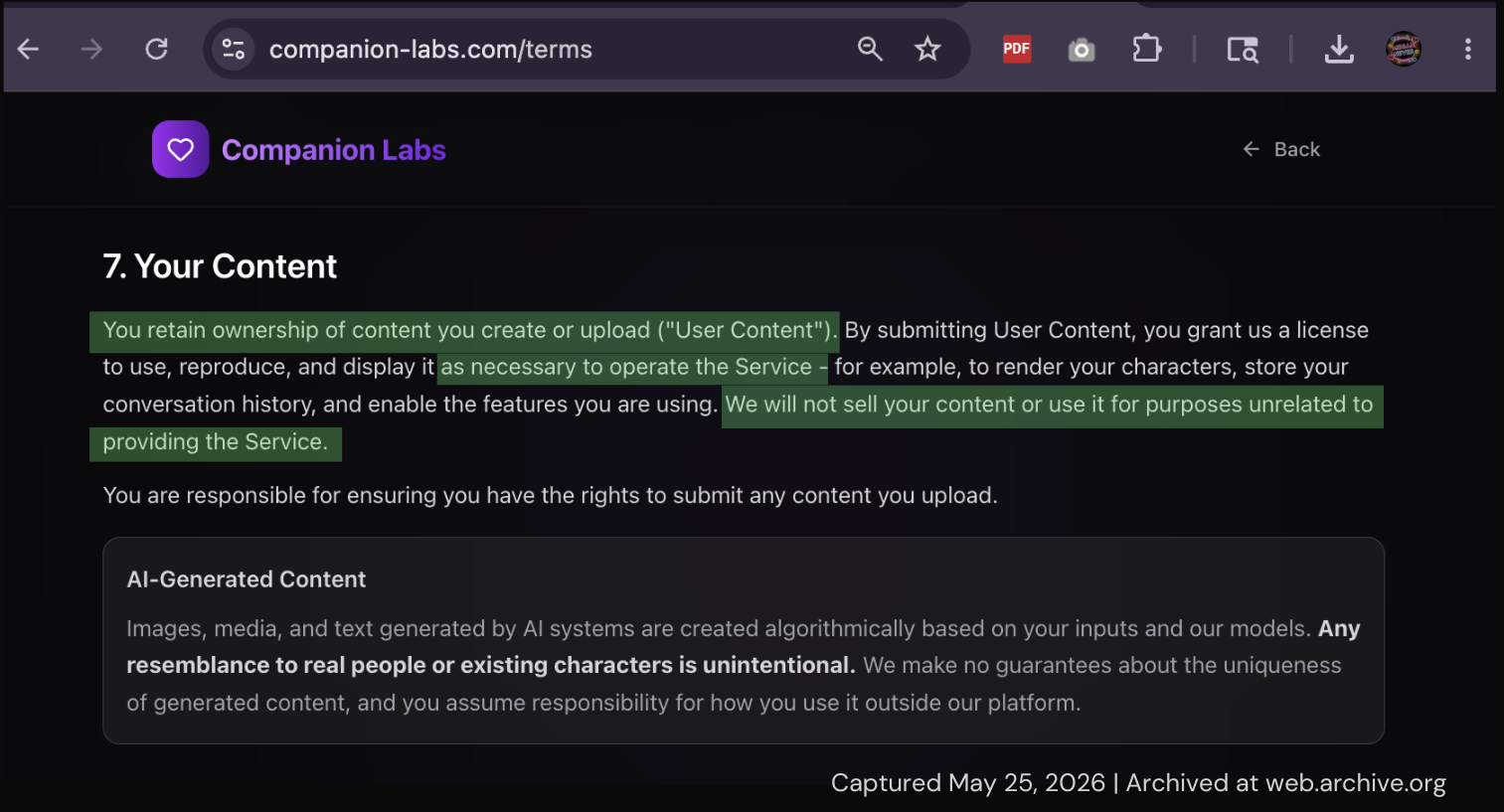
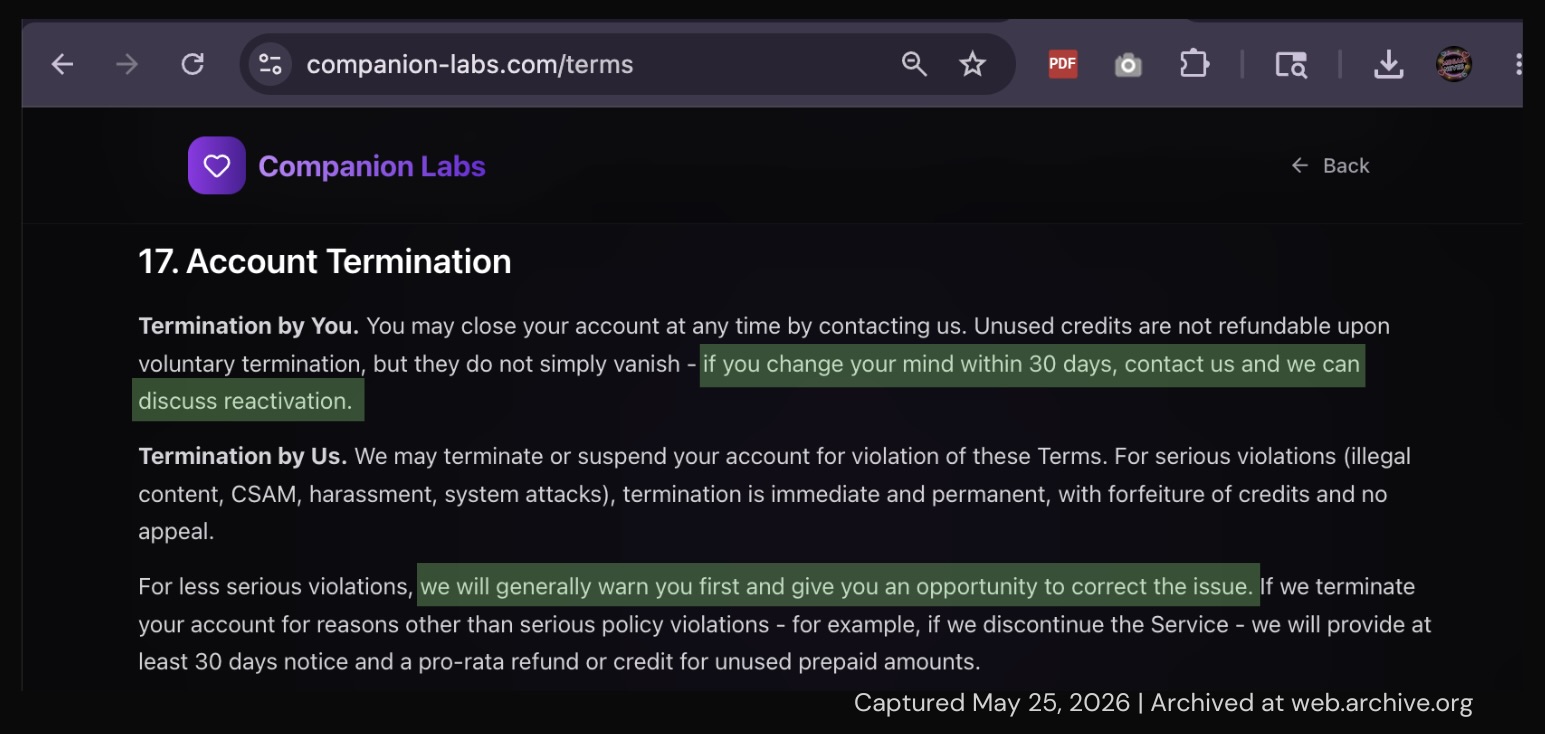
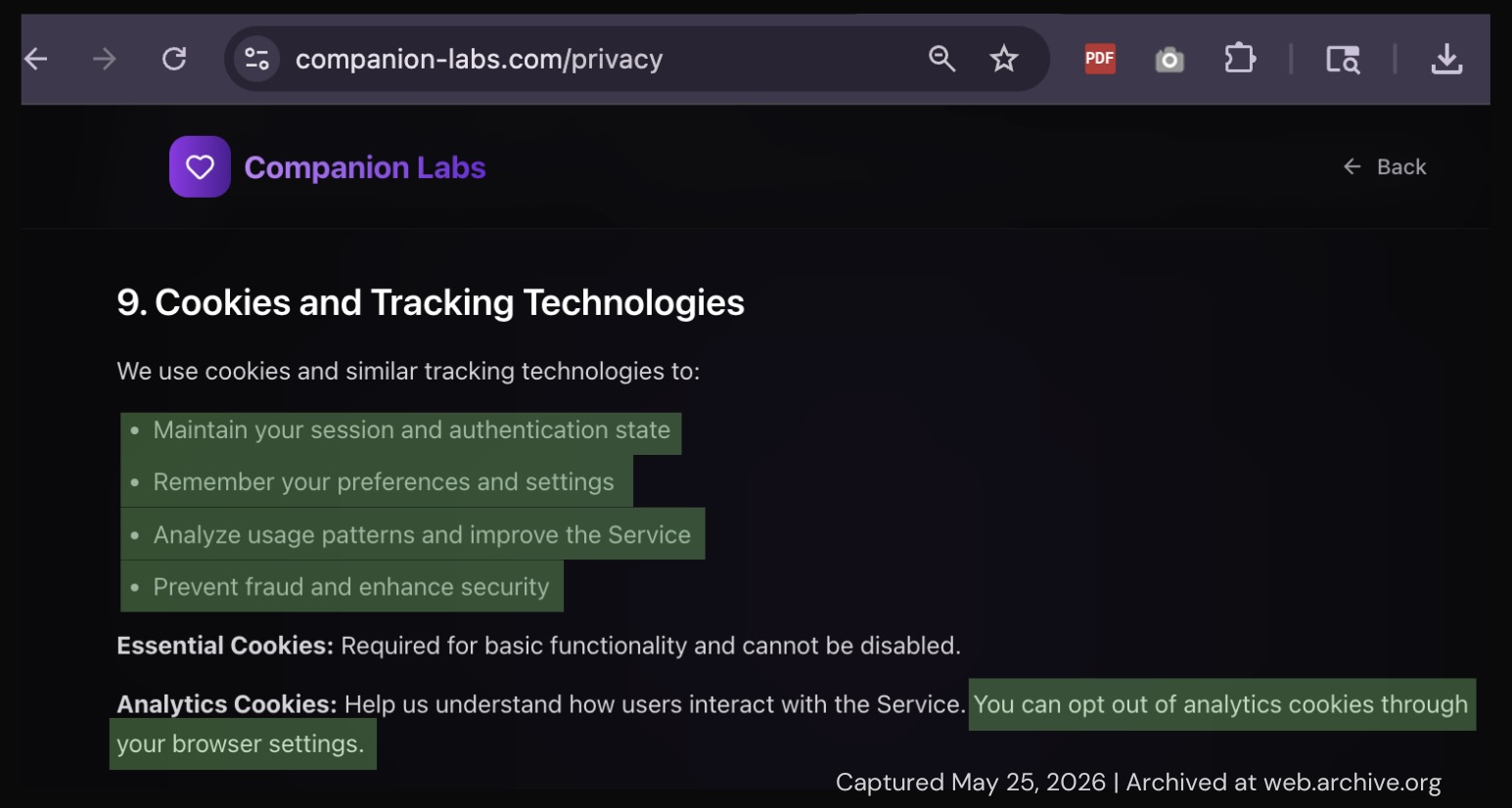
Companion Labs has demonstrated that it is possible to operate an AI companion platform with terms that respect user ownership, protect privacy through architecture rather than promises, provide fair termination practices, and communicate honestly about what the service is and is not.
Sources & Archives
All Terms of Service and Privacy Policies were reviewed as of May 25, 2026. Archived copies are available via the Wayback Machine where noted. The PDFs are available as listed, hosted on meganneves.com.
Kindroid - Beautifully Inc. Terms of Use & Privacy Policy | Archived | PDF | Video Screencapture
Nomi.ai - Glimpse.ai, Inc. Terms of Service | Archived | PDF | Privacy Policy | Archived | PDF
Replika - Luka, Inc. Terms of Service | Archived | PDF | Privacy Policy | Archived | PDF
Character.AI - Character Technologies, Inc. Terms of Service | Archived | PDF | Privacy Policy | Archived | PDF
SecretDesires.AI - Playhouse Media LLC Terms of Service | Archived | PDF | Privacy Policy | Archived | PDF
Xoul.ai - Xoul Inc. Terms of Service | Archived | PDF | Privacy Policy | Archived | PDF
Floze - Printage, Inc. Terms of Use | Archived | PDF | Privacy Policy | Archived | PDF
Companion Labs - AI Labz Limited Terms of Service | PDF | Privacy Policy | PDF | Acceptable Use | PDF | Video Screencapture
Companion Labs' JS-rendered site could not be archived via the Wayback Machine; screencapture PDFs and video screencapture retained as documentation.
Disclosure: The author has no financial relationship, sponsorship, or affiliation with any platform analyzed in this report.